The LinkedIn Algorithm Is Weird
I’ve been experimenting with LinkedIn posts for a while now. Nothing particularly scientific. I’ve tried different hooks, hashtags, posting frequencies, personal stories, professional subjects, poetry, AI-related posts, ITSM posts, direct typing rather than pasting, and deliberately changing my usual writing style.
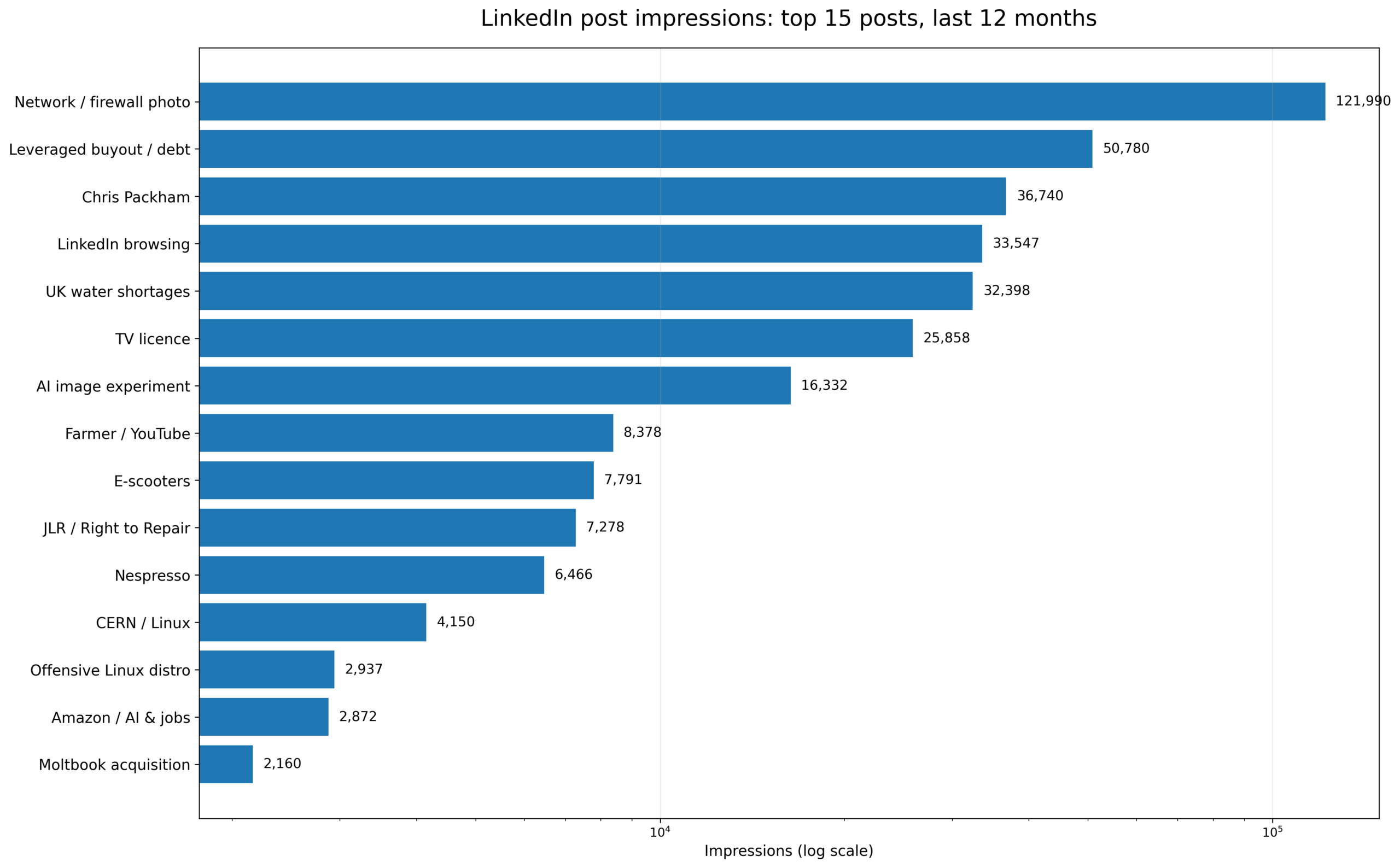
The results have been wildly inconsistent. Over roughly the last year, my posts generated more than 423,000 impressions, but the distribution was heavily concentrated: my top ten posts produced about 80% of all impressions. One post alone, based around a photograph of network equipment labelled “CUT HERE TO ACTIVATE FIREWALL”, generated more than 121,000 impressions.
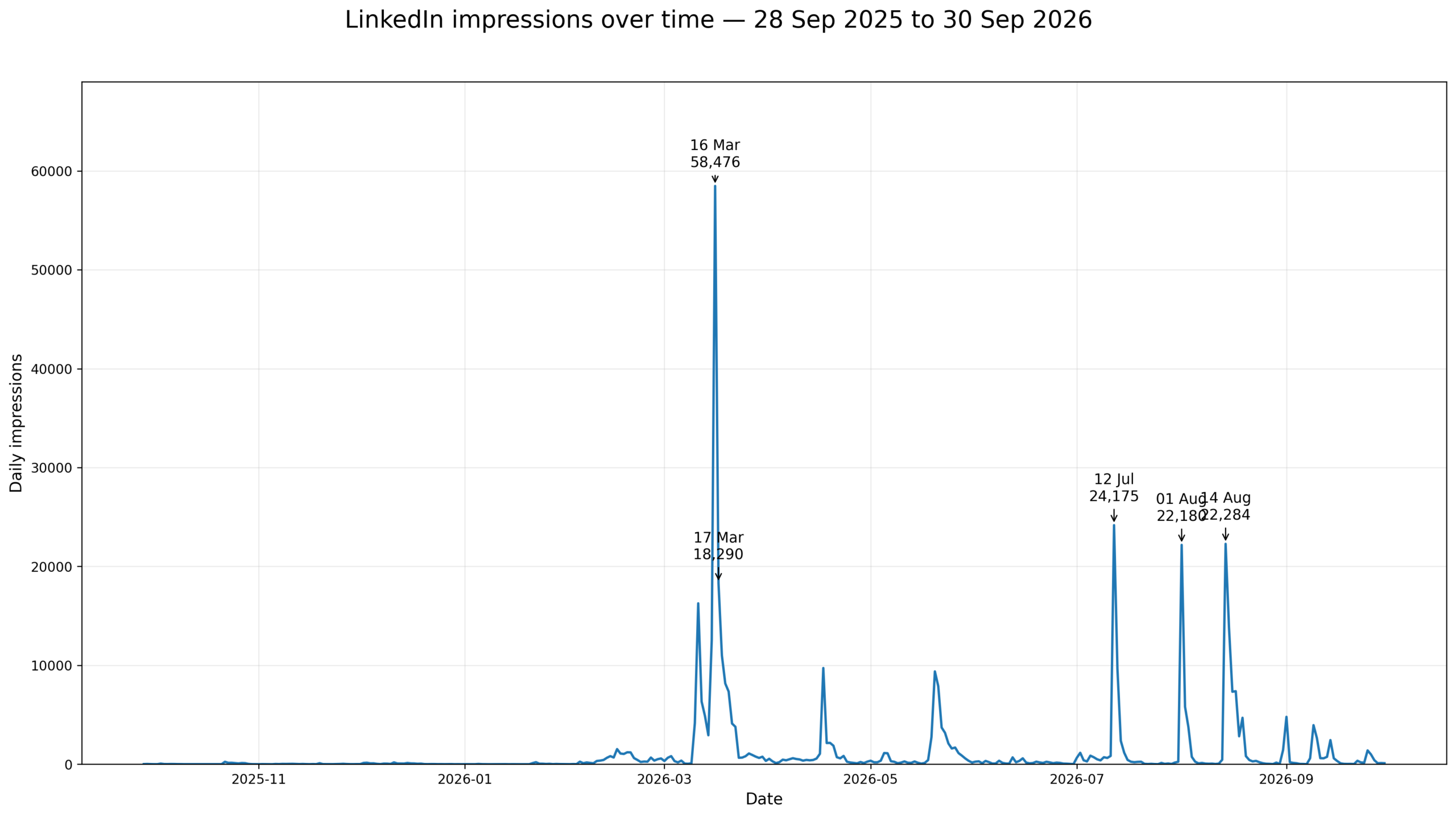
The daily figures are even stranger. Most days are fairly quiet, then LinkedIn occasionally seems to open the floodgates. One day in March produced more than 58,000 impressions.
So what seems to work? The strongest posts tended to have something concrete at the centre of them: Jaguar Land Rover, CERN, Amazon. They also had a broader human issue attached, such as jobs, ownership, software support, redundancy, rehiring or right-to-repair. And usually there was some tension or contradiction.
The Amazon post was particularly interesting. It reached 2,872 impressions in the latest export, and the audience demographics suggest LinkedIn actively found people connected to the subject: 8% of the audience worked for Amazon, another 7% for AWS, and Seattle was one of the biggest locations. That is very different from simply showing the post to more random people.
By comparison, a post asking “Can you actually AI-proof your career?” reached only around 100 impressions. Both posts involved AI and jobs, but one was an abstract discussion about AI, while the other was about Amazon making people redundant and then apparently wanting some of them back. That may be the important distinction.
I also tried an ITSM post comparing my 50-year-old Beetle with a legacy IT platform. I rather liked it. LinkedIn didn’t. That one reached just over 100 impressions. A personal post beginning “I scared an old friend of mine yesterday” did rather better, eventually reaching nearly 600 impressions, with most coming from outside my network.
So my current working theory is fairly simple: posts seem to travel further when LinkedIn can easily work out who might care about them, and when there is something concrete, recognisable and slightly uncomfortable for a human to react to.
What doesn’t appear to guarantee anything is simply writing a “good LinkedIn post”. Hooks don’t guarantee it. Hashtags don’t guarantee it. Writing everything yourself doesn’t guarantee it. AI doesn’t guarantee it. ITSM certainly doesn’t guarantee it.
And low engagement does not necessarily mean a bad post either. If LinkedIn shows something to 5,000 people and nobody reacts, that tells you something. If it shows it to 25 people, perhaps it simply never really tested it.
So have I worked out the LinkedIn algorithm?
No.
But after a year of watching it, I’m increasingly confident about one thing:
The LinkedIn algorithm is weird.